
In this article
Before there was a road movie, there was a road. In the spring of 1964, novelist Ken Kesey and a hand-picked crew of friends climbed into a 1939 International Harvester school bus they had painted in Day-Glo colors, loaded tape recorders and notebooks, and pulled out of a suburban driveway heading for the West Coast. The bus had no real destination. Its purpose was the trip itself, and the record of the trip was to be made on the way. They called the bus Further, and they called themselves the Merry Pranksters.
Few small, improvised schemes have left a larger cultural footprint. The Pranksters' 1964 cross-country drive, and the Acid Tests that grew out of it when they got back to the Bay Area, seeded the San Francisco scene that became the Summer of Love, gave the Grateful Dead their original crew of roadies and lightshow artists, and produced a phrase that still travels: "on the bus, or off the bus." This article traces the people, the trip, and what that phrase came to mean.
La Honda: The Cabin Before the Bus
To understand the Pranksters, you have to start in La Honda, California, in the early 1960s, about an hour south of San Francisco along the redwood coast. Ken Kesey had moved there with his family in 1960, partly to write, partly to be near Stanford, where his friend Vic Lovell was finishing a graduate degree in psychology. Lovell had access to a small room in the Stanford psychology department where government-funded researchers were running controlled studies on the effects of LSD and other psychedelics. Kesey volunteered for the studies, first the LSD trials, then later psilocybin, and was paid, by some accounts, by the dose.
The trials were part of a much larger postwar research program. In the 1950s and early 1960s, before the cultural backlash against psychedelics hardened into law, American universities were running thousands of sessions with LSD, mescaline, and psilocybin. Researchers at Stanford, Harvard, and a handful of European centers believed these compounds opened therapeutic and creative possibilities. Kesey's biography traces these trials directly to his time at Stanford. The experience he accumulated there would inform his writing for the rest of his career and became, over the next few years, a recruiting tool for the wider La Honda circle.
At La Honda, Kesey invited a rotating cast of friends, neighbors, Stanford graduate students, and Beat-adjacent writers to share the experience. The gatherings were less formal than the word "experiment" suggests. People would take a hit of LSD, or mescaline, or psilocybin, and the evening would unfold across the cabin, the porch, the redwoods, and the lawn. Music was important. So were costumes, pranks, and the slow ritual of staying with an experience instead of trying to talk your way out of it. The gatherings drew writers (Ken Babbs, Carolyn Adams, who later became "Mountain Girl"), musicians, Stanford types who would later show up in the CIA's periphery, and the first generation of what would become the Pranksters.
By 1963, the La Honda evenings had accumulated enough stories, characters, and a critical mass of regular participants that Kesey and his closest circle began to plan something more ambitious: a trip across the country. The bus would be the vehicle. The trip would be a continuous, recorded experience. The destination was deliberately undefined.
Ken Kesey, the Stanford Set, and the Brothers of the Immaculate Conception
Ken Kesey arrived at La Honda already famous. His 1962 novel "One Flew Over the Cuckoo's Nest" had sold briskly and won the attention of the literary mainstream, and he was at work on a second novel ("Sometimes a Great Notion") that would appear in 1964. The writerly success gave him financial flexibility and a wider social network than most of his LSD-taking peers could draw on, but he was also ambivalent about the literary world he had moved into. The Pranksters were, in part, an alternative to it.
Around Kesey gathered what he sometimes called the Brothers of the Immaculate Conception, a loose fraternity of friends who shared an interest in altered states, in breaking the polite boundary between performer and audience, and in the kind of structured mischief that the Beats had practiced in a smaller key. Ken Babbs, an ex-Marine and a writer in his own right, was the most loyal of these friends. Mike Hagen, a friend from Kesey's Stanford days, helped engineer practicalities. Stewart Brand, later famous for founding the Whole Earth Catalog, was in the wider circle. Mountain Girl (Carolyn Adams Garcia) had two children with Jerry Garcia in the early 1960s and would later become a significant figure in the Grateful Dead's institutional life.
Behind the social network was a less obvious institutional one. Several of the Stanford-connected members of the circle had been exposed, directly or indirectly, to MK-Ultra and related Cold War-era government programs studying LSD as a potential tool of interrogation or mind control. The exact degree of overlap between the La Honda circle and these programs remained a matter of debate and memoir for decades. What is clear is that the La Honda evenings were, at minimum, a recovery of compounds that had been studied as weapons, and used instead as instruments of intimacy, art, and what the Pranksters themselves called "play."
The Pranksters Roster
Twelve people would end up on the bus for various legs of the 1964 trip, with a rotating cast of friends joining and leaving along the way. The core crew was a deliberately mixed group, not all writers, not all musicians, not all Stanford grads.
Ken Kesey was the leader and the project's intellectual center. He had taken more LSD than almost anyone in the group and was determined to bring the La Honda experience out of the cabin and onto the open road.
Neal Cassady drove the bus. Cassady was already legendary in Beat circles, the model for Dean Moriarty in Jack Kerouac's "On the Road", and by 1964 he had been through prisons, manic episodes, and a long personal collapse. Kesey invited him because no one alive could drive a car like Cassady could. Cassady, in turn, saw the bus trip as another way to keep moving.
Ken Babbs served as Kesey's second in command and chronicler, fiddling constantly with tape recorders and notebooks and conducting almost everyone he met for the "on the bus / off the bus" question that gives this piece its title.
Carolyn "Mountain Girl" Adams: the only woman among the core Pranksters for most of the trip, she would later become one of the central organizers of the Grateful Dead's nonprofit and benefit infrastructure.
Mike Hagen: a Stanford-educated friend of Kesey who became the trip's logistics manager, photographer, and documentarian.
Stewart Brand: future founder of the Whole Earth Catalog, present early in the project, partly as observer.
Sandra Stanley, Gail Stanley, Donna Hightower, and Page Smith: friends and partners of Kesey and Babbs who joined for portions of the trip and made the bus's interior life possible.
George Walker: an early Prankster whose contributions to the bus's visual identity were foundational. Walker designed the swirl logo that would later become the Grateful Dead's "Stealie" emblem, after the Pranksters themselves.
John "Irene" MacLear, Ron "Hawk" Hawkins, and a handful of Oregon neighbors rounded out the rolling community. The bus was a working social experiment in shared space, cramped, smoky, sometimes incoherent, sometimes transcendent, with Cassady at the wheel most of the time.
The 1964 Further Trip
The bus trip began, by most accounts, in late April 1964 from Kesey's place in La Honda. Cassady took the wheel almost immediately and drove Further east, then south, then in long looping runs toward the Southwest, the Gulf Coast, New York, and back west. The trip took roughly three months and covered thousands of miles, with stops for gas, for friends who joined briefly, for police encounters, for breakdowns, and for the rare party where the bus pulled up in front of an unsuspecting crowd.
On board was a small recording studio's worth of equipment. Kesey and Babbs taped almost everything. Mike Hagen shot photographs. Mountain Girl kept notes. The trip was intended from the start as an artwork, and the artwork was being made in real time. The resulting hours of tape, much of it later released as a series called "The Acid Test Tapes," became one of the foundational sound documents of the counterculture.
Enjoying this? Subscribe free.
Every Tuesday: psychedelic science, policy, and culture, decoded for humans.
You'll also get our free Top 10 Psychedelic Books guide.
You're in! Redirecting to your free guide...
The trip's most famous moment was a visit to Millbrook, New York, the upstate estate that Timothy Leary and Richard Alpert (later Ram Dass) had rented from a wealthy Hitchcock heir as a base for their own psychedelic research. The Pranksters pulled in, painted bus and all, and the two scenes met, the West Coast eventually-arriving Pranksters and the East Coast Leary circle, both committed to the proposition that consciousness could be reorganized through compounds and shared experience. The Millbrook visit was brief, but it cemented an alliance that would shape the next two years of American counterculture. Leary and Kesey would not always agree, but they had a common project, and they had, in each other, company.
The bus returned to La Honda in the late summer of 1964. By then, the trip had failed as a destination and succeeded as a method. The Pranksters had learned how a small group, moving together through unfamiliar territory, could create a self-sustaining social world, one in which ordinary categories of stranger and acquaintance, sober and high, performance and audience, were softened to the point of disappearing.
The Acid Tests
When the Pranksters got home, Kesey did not sit still. Working with local promoter Ken Babbs and Stewart Brand, he organized a series of public events in the Bay Area, first in private homes, then in rented halls, then in a former automotive shop in San Jose that became the central venue, called the Acid Tests. The format was more or less consistent: take LSD, mostly distributed in liquid form in small envelopes; invite a mix of strangers, friends, musicians, and dancers; provide loud music, projections, and lights; and let the event run into the morning.
The Acid Tests were, in design, an attempt to recreate the bus experience for larger audiences. They were not lectures. They were not therapeutic sessions. They were experiments in collective altered consciousness, legal during this window of time, before California's 1966 ban on LSD and the broader federal crackdown that followed. Substance was present, but the structure was the point.
A 1965 Acid Test at the San Jose hall, drawing several hundred people, is the event most often cited as the moment the Pranksters' world and the emerging San Francisco music scene merged. The Warlocks, a Bay Area jug band that had been refining its sound in a different but adjacent social world, played the event and stayed for the duration. Jerry Garcia's band would rename themselves the Grateful Dead shortly after, partly because the Warlocks name was already claimed by another group on the East Coast, and partly because a name that meant "merry" and "thankful" and "dead" at once felt better suited to the times.
A second wave of Acid Tests in late 1965 and 1966, often organized in partnership with the Grateful Dead and the Merry Pranksters' visual artists (Walker, his wife Bob Thomas, and others), drew thousands. The events were ticketless, often pay-what-you-can, and explicitly intended to break the boundary between performer and audience. People who attended the earliest Acid Tests describe a feeling less like a concert and more like a shared, sustained hallucination, a kind of collective dream in which the building, the music, the projections, and the people all held together as a single field of attention.
The Grateful Dead and the Warlocks
The handoff from the Pranksters to the Grateful Dead is one of the central stories of 1960s American music, and it is more entangled than the usual summary suggests. The Pranksters were not a band. The Warlocks, who became the Grateful Dead, were a band; they needed a scene and a social world, and the Acid Test scene was waiting for them.
By the winter of 1965, the band was playing Acid Tests under their old name, and the longer they played, the clearer it became that the events needed them. Live music at the volume and length the Pranksters wanted, sets that could run from midnight to dawn, was not something a local folk group or a hired jazz trio could deliver. The Warlocks were already into extended improvisation. They had a fan in Owsley Stanley, the underground chemist who would later become their sound engineer and benefactor, and who supplied much of the LSD that flowed through the Acid Tests.
Stanley, also called "Bear," is a second link in the chain. He was an independent researcher and cook who produced high-quality LSD in small, single-dose envelopes marked with the Grateful Dead lightning bolt and, later, the Pranksters' swirl. Stanley's production methods were so clean that, decades later, chemists analyzing his surviving samples found them to be within standard pharmaceutical tolerances, a fact that earns him a strange place in the informal history of harm reduction in the era.
Whether the band would have become the Grateful Dead without the Pranksters is hard to say. What is clear is that the social infrastructure the Pranksters built, the Acid Tests, the free-form audience arrangements, the playful indifference to commercial categories, gave the band the conditions it needed to grow. The band's early sound, the visual identity of the Stealie (designed by Walker and Owsley), and the touring apparatus of roadies and lightshow artists all trace back through the Pranksters' aesthetic.
"On the Bus, or Off the Bus"
Ken Babbs's running question, asked of nearly everyone the bus pulled up to in 1964, was not a poll. It was a sorting. Were you the kind of person who wanted to climb aboard a strange, painted vehicle and see what happened, or were you the kind of person who, after a polite conversation, watched the bus pull away without regret? The phrase "on the bus, or off the bus" entered the counterculture's working vocabulary through Babbs's voice, through the tape recordings, and through Tom Wolfe's 1968 "The Electric Kool-Aid Acid Test", which made the trip and the question famous.
Wolfe's book, written in his characteristic New Journalism voice and published during the same year as the Summer of Love, did as much as any single text to disseminate the cultural frame around the Pranksters. Wolfe was not a participant in the bus trip, he reconstructed it from interviews with Kesey, Babbs, and others, but he caught the social logic of the scene, and he wrote the phrase into the broader culture in a way that made it stick.
"On the bus" came to mean committed to the experiment in altered consciousness, in communal living, in improvised social forms, in many cases, in psychedelics themselves. "Off the bus" came to mean committed to the existing structures, career, sobriety, conventional social roles. By 1968, the phrase was a divider as well as a description. Not everyone who was on the bus stayed on, and not everyone who was off it felt at peace with the divide.
The phrase was never entirely binary. It is best understood not as a literal question but as a posture. Were you willing to step out of ordinary categories and into an improvised arrangement that might or might not work? Were you willing to be recorded, photographed, dressed up, drugged, and asked strange questions in front of strangers? Were you able to play? The phrase has outlived the 1960s for the same reason, it names a question that does not stop being relevant.
Legacy and Where the Lineage Runs Today
The Pranksters did not stay on the bus forever. By the end of 1966, LSD was illegal in California and increasingly prosecuted federally. The Pranksters scattered, some to longer-term psychedelic projects, some to upstate farms (Wavy Gravy and others picked up the communal baton), some into alcohol and disillusionment. Cassady died in Mexico in 1968, not long after leaving the band he had been touring with, and the loss was felt across the scene as a hinge moment.
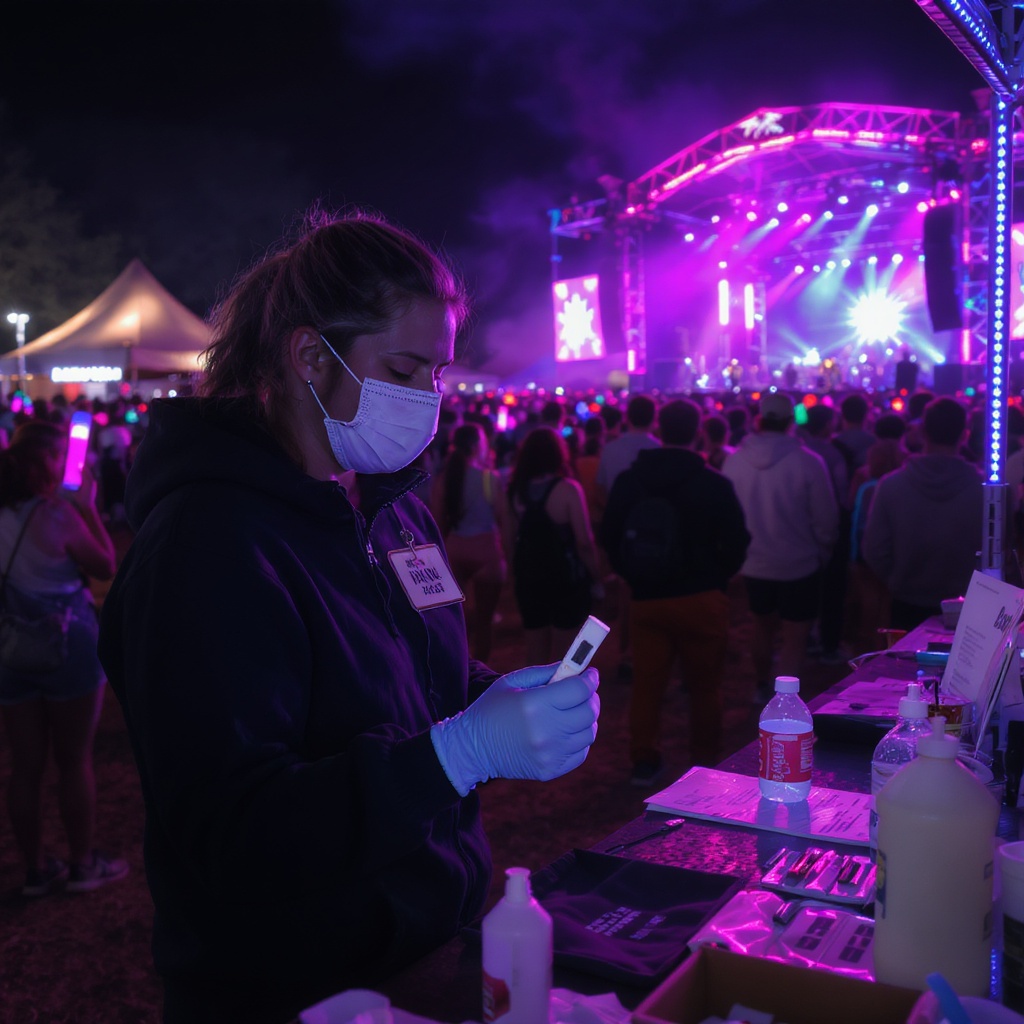
But the infrastructure the Pranksters built, the lightshow artists, the sound engineers, the workshop philosophies, the community fundraisers, the explicit understanding of music as a participatory social form rather than a commercial entertainment, is the same infrastructure that ran the Summer of Love, the free-form FM radio stations of the late 1960s, the large outdoor festivals of the 1970s, and a great deal of contemporary festival culture. When today's harm reduction volunteers at festivals, the model our harm reduction at festivals piece describes, set up a peer support tent at a multi-day event, the operational idea of "set and setting" they are working with is, in significant part, a refinement of ideas the Pranksters and the early Acid Test organizers developed by trial and error.
Modern clinical research on the compounds Kesey took at Stanford, LSD, LSD in therapy, psilocybin, MDMA, ayahuasca, and others, proceeds in a regulatory environment the Pranksters would not have recognized. For all the differences, the contemporary hypothesis that these compounds can be useful when paired with structured, attentive human support arrives at a place that the La Honda evenings, the bus, and the Acid Tests had already reached by practice. The arrangement the Pranksters were after, people in altered states, held by a small, patient community, in a setting that does not pretend to be the everyday world, is the same arrangement now under study at research centers at Johns Hopkins, Imperial College London, and elsewhere.
Legal questions that US psychedelic laws now answer in different ways in different states were not questions the Pranksters worried about in 1964. Kesey himself was arrested in 1965 for possession of marijuana and was sent to prison in 1967 on related charges. The compounds the Pranksters worked with are, in most US jurisdictions, still compounds the law treats one way and the science now discusses in another. Whether that arrangement is sustainable, or even coherent, is a question the next decade will decide.
For more on the compounds at the center of the Pranksters' experiment, see our explainers on what psychedelics actually are and microdosing. For a closer look at how some of the Pranksters' operational ideas travel in present-day festival culture, see our harm reduction at festivals piece.
The clinical science now being done at UCSF and Hopkins on the same compounds the Pranksters worked with in the 1960s arrives at a compatible, if very differently organized, conclusion about what those compounds can do in a structured setting.
This article is historical. None of the compounds discussed are legal for general use in the United States, and possession outside approved research settings can carry serious penalties.
Related reading


Enjoying this? Subscribe free.
Every Tuesday: psychedelic science, policy, and culture, decoded for humans.
You'll also get our free Top 10 Psychedelic Books guide.
You're in.
Redirecting to your free book guide...