In this article
On the afternoon of April 19, 1943, a Swiss chemist named Albert Hofmann set down his pipettes, told his assistant he felt unwell, and climbed onto his bicycle to ride home from the Sandoz Laboratories in Basel.
He never quite made it to normal. By the time he arrived at his house, the world had transformed. Objects and surfaces shifted and pulsed. His neighbor's face, when she brought him milk, appeared as a malevolent mask. The room swam. He felt alternately terrified and euphoric. Then, over the course of the evening, the most intense part passed, and Hofmann found himself looking at the garden outside his window, and finding it beautiful in a way that seemed almost absurdly vivid.
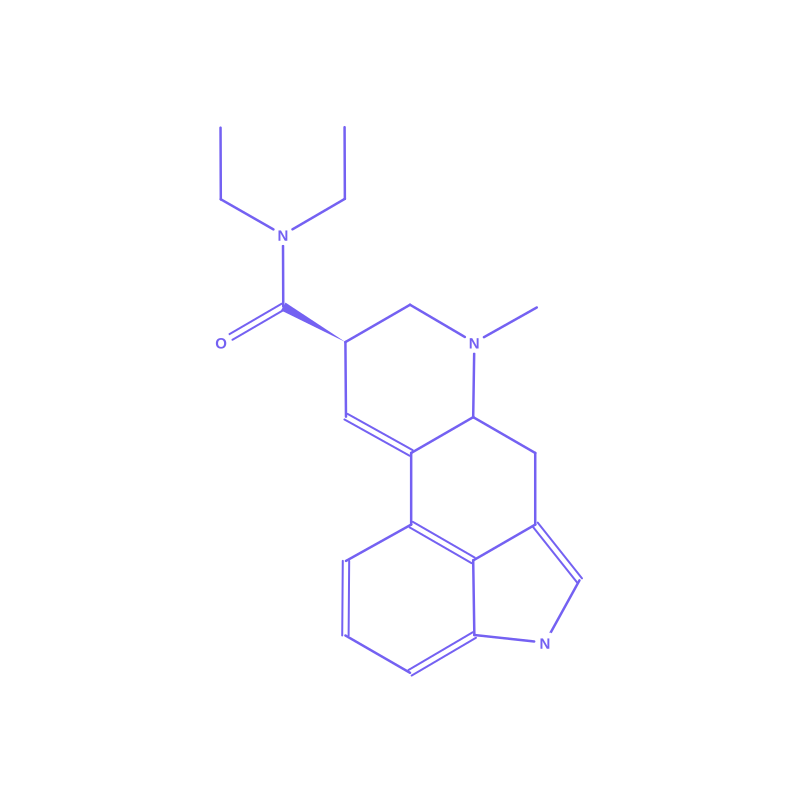
He had synthesized the compound five years earlier and then set it aside. He returned to it by accident. What he had made, lysergic acid diethylamide, LSD-25, would go on to shape a counterculture, disturb a government, and, now, nearly eight decades later, enter clinical trials as a potential treatment for anxiety disorders.
The story of LSD is not a simple one. It's a story about a brilliant chemist who didn't know what he'd found, a government that thought it could weaponize consciousness, a generation that decided to ingest it by the millions, and a scientific community now cautiously trying to determine what it actually does to the brain.
What Is LSD?
LSD is a semi-synthetic compound, meaning it requires a naturally occurring precursor but is completed in a laboratory. Its full name is lysergic acid diethylamide. It's a member of the ergoline family, built on a rigid four-ring scaffold that distinguishes it chemically from the tryptamine compounds. DMT, psilocin, that act on the same receptor.
The key target is the serotonin 5-HT2A receptor, the same receptor that psilocybin's active form (psilocin) binds. But LSD's binding is distinct in a critical way: it fits into the receptor like a key that gets trapped in the lock. The receptor closes over the LSD molecule, slowing its dissociation dramatically. This is the primary reason an LSD experience lasts 8-12 hours, compared to 4-6 hours for psilocybin or 15 minutes for smoked DMT. The compound sits on the receptor far longer because the receptor physically holds it there.
LSD is extraordinarily potent. An effective dose is measured in micrograms, typically 75-150 micrograms for a full experience. A single gram of LSD is enough to produce several thousand doses. This potency has practical consequences: street doses are nearly impossible to verify by sight or feel, and the difference between a 75 microgram and a 200 microgram dose is not a larger version of the same experience, it's a qualitatively different one.
The Fungus That Started Everything
LSD begins with ergot. Claviceps purpurea is a parasitic fungus that grows on rye and other grains, replacing kernels with hard, dark purple bodies called sclerotia. For much of human history, ergot was a catastrophe. When contaminated grain was milled and eaten, it caused ergotism, a horrifying condition that presented in two forms: convulsive (seizures, hallucinations, mania) or gangrenous (constriction of blood vessels leading to burning sensations and loss of limbs). Medieval Europeans called the gangrenous form "St. Anthony's Fire." Epidemics swept through communities for centuries. Some historians have proposed ergot-contaminated grain as a contributing factor to the Salem witch trials.
The fungus contains a family of compounds called ergot alkaloids, built on the ergoline scaffold that Hofmann would later use. Ergot was of pharmaceutical interest because some alkaloids had potent effects on smooth muscle, particularly uterine muscle, which made them relevant to obstetrics and the treatment of migraines. Sandoz Laboratories in Basel had been systematically synthesizing ergot derivatives through the 1930s, looking for medically useful compounds.
Albert Hofmann was the chemist assigned to the project.
A Chemist in Basel
In 1938, Hofmann synthesized the twenty-fifth compound in his ergot derivative series: lysergic acid combined with diethylamine, producing LSD-25. He was looking for a circulatory and respiratory stimulant. In animal trials, the compound produced unusual restlessness and excitation in mice, results that didn't fit the profile Sandoz was looking for. The research was discontinued. LSD-25 was shelved.
Five years later, in April 1943, Hofmann had a "peculiar presentiment", his phrase, that the compound was worth another look. While resynthesizing a sample, he absorbed a small amount through his fingertips, possibly through a skin contact that bypassed normal metabolism. That was April 16th, now sometimes called "Bicycle Day Eve." The effects were mild and he attributed them to dizziness.
On April 19th, he decided to self-experiment intentionally. He took what he considered a conservative dose, 0.25 milligrams, or 250 micrograms. He had no reference point. He didn't know that the threshold dose for LSD is closer to 20 micrograms. He had taken, by modern standards, a substantial dose, well above what most experienced users would choose.
The bicycle ride home was, accordingly, dramatic. His assistant accompanied him. Hofmann later wrote that the bicycle seemed to be moving but going nowhere, that the world was transformed and threatening, that a familiar neighbor appeared demonic. Then the terror subsided, and what remained was wonder.
He documented everything. He was rigorous about it. He described the experience in clinical detail, noted its timeline, and concluded that he had discovered a psychoactive compound of exceptional potency. He was 37 years old. He would live to be 102, spending much of the intervening time thinking about what he'd found.
The US Government Gets Involved
In 1947, Sandoz published Hofmann's findings in the scientific literature and began distributing LSD to researchers worldwide for investigational purposes. The intent was legitimate scientific study. What followed was not entirely that.
By the early 1950s, the CIA had taken notice. The Cold War had created intense institutional interest in the possibility of mind control, the question of whether an enemy state could chemically manipulate prisoners, soldiers, or targets into behaving in desired ways. In 1953, the CIA launched Project MKUltra, a covert program that would spend the next two decades administering LSD and other compounds to human subjects, often without their knowledge or consent.
The subjects included prisoners, psychiatric patients, military personnel, and ordinary citizens. Experiments were run in hospitals, safe houses, and military installations. In the most notorious case, a CIA employee named Frank Olson was dosed without his knowledge at a meeting in 1953. Nine days later he died, falling, or being pushed, from a hotel window in New York. His death was ruled a suicide and the CIA's involvement was not revealed for more than two decades.
MKUltra produced no useful mind control technology. LSD does not make people reliably compliant or suggestible in the ways the CIA hoped. What it does is unpredictable, highly context-dependent, and not remotely amenable to the kind of control the program sought. The program was officially shut down in 1973, after a congressional investigation. Many records were destroyed on the order of CIA Director Richard Helms in 1972. The full scope of MKUltra has never been precisely established.
Harvard, Leary, and the Counterculture
While the CIA was running its covert program, legitimate researchers were also working with LSD through the 1950s and early 1960s. Thousands of papers were published. Psychotherapy with LSD showed genuine promise, the same promise that psychedelics broadly are showing again in clinical research today.
Then Timothy Leary arrived.
Leary was a clinical psychologist at Harvard who first encountered psilocybin mushrooms in Mexico in 1960 and returned convinced that psychedelics represented a revolutionary tool for human psychology. With his colleague Richard Alpert (later Ram Dass), he ran the Harvard Psilocybin Project. The work was controversial, less because of the science than because of the attitude Leary brought to it, which was increasingly evangelistic. Harvard fired them both in 1963.
By then Leary had shifted his focus to LSD, which was more potent, more accessible, and perfectly suited to his gift for provocation. He coined the phrase "turn on, tune in, drop out." He told a generation to mistrust anyone over thirty. He became the public face of a cultural movement that the United States government found deeply threatening, less because of the pharmacology than because of what the pharmacology seemed to be connected to: civil rights organizing, anti-Vietnam sentiment, the wholesale rejection of mainstream American values.
The association between LSD and political radicalism was partly real, partly a projection. Not everyone who used LSD in the 1960s was a political dissident. But the cultural moment fused them, and the government responded to both at once.
Enjoying this? Subscribe free.
Every Tuesday: psychedelic science, policy, and culture, decoded for humans.
You'll also get our free Top 10 Psychedelic Books guide.
You're in! Redirecting to your free guide...
The Crackdown
LSD was made illegal in the United States in 1968. The Controlled Substances Act of 1970 classified it as a Schedule I substance, defined as having high potential for abuse, no currently accepted medical use, and a lack of accepted safety data. The scheduling halted nearly all legitimate research. Clinical studies that had been showing real promise in treating alcoholism and anxiety in the terminally ill were abandoned. Sandoz stopped distributing the compound for research purposes.
The scientific community largely lost access for twenty years.
What didn't stop was use. LSD moved underground, became embedded in music culture and festival circuits, mutated in quality and dose as manufacturing moved away from pharmaceutical settings. The "bad trip" became the dominant cultural narrative, a cautionary tale that displaced the more complex picture the researchers had been building. The compound's cultural image was set by its uncontrolled, non-therapeutic use rather than by the clinical findings.
How LSD Actually Works
The neuroscience of LSD has become clearer only recently, partly because it's difficult to study Schedule I substances, and partly because the imaging technology to observe the drug's effects in real time in living brains has only reached sufficient resolution in the past decade.
The core mechanism, 5-HT2A agonism, is shared with psilocin and DMT, but the dynamics differ significantly. LSD binds to the receptor and essentially gets trapped there, slowing the receptor's ability to signal the compound's departure. The receptor enters a prolonged activation state, which is why the experience extends for 8-12 hours instead of the 4-6 typical of psilocybin.
Beyond the 5-HT2A receptor, LSD has an unusually broad binding profile, it hits dopamine receptors, adrenergic receptors, and a range of other serotonin receptor subtypes. This breadth of action likely contributes to its distinctive phenomenology: where psilocybin tends toward emotional and introspective depth, LSD often produces more cognitive stimulation, sensory amplification, and what users describe as a "wired" quality that psilocybin doesn't typically generate.
The fMRI data tells an interesting story. A landmark 2016 study from Imperial College London used brain imaging to observe LSD effects in real time and found that visual cortex activity became "uncoupled" from visual input, the eyes were open and processing light normally, but the visual cortex was generating activity largely independent of what the eyes were seeing. The researchers also observed increased entropy across brain networks, a breakdown of the ordinary hierarchical organization that governs normal cognition. The "default mode network", the brain's resting-state self-referential system, was disrupted in ways similar to those seen with psilocybin.
The Experience
An LSD experience, at a typical dose, has a distinct arc over 8-12 hours. The onset takes 30-90 minutes depending on dose and metabolism. The come-up is often characterized by anxiety and physical arousal, increased heart rate, dilated pupils, a sense of anticipation that can tip into unease. Then the main effects arrive.
What distinguishes LSD phenomenologically is its combination of sensory amplification and cognitive stimulation. Colors sharpen and intensify. Music becomes immersive in ways that feel architectural, it has spaces and structures that seem to be perceived directly rather than just heard. At higher doses, geometric visual patterns appear in the visual field, and the boundary between perception and imagination becomes unclear.
The cognitive quality of an LSD experience differs from that of psilocybin in ways that users consistently report. Psilocybin tends to produce emotional depth and surrender; LSD tends to produce racing, highly associative thought. This quality can be valuable, creative connections, novel framings of old problems. It can also generate "thought loops" that become exhausting or frightening: the same idea circling obsessively, unable to resolve or move on. Managing this cognitive intensity is part of why set, setting, and preparation are considered essential rather than optional by researchers and experienced practitioners alike.
The long duration is both a feature and a challenge. A psilocybin therapeutic session can be managed within a single clinical day. An LSD session of similar intensity requires considerably more time, staffing, and support, a practical obstacle to clinical use that researchers have had to account for explicitly in trial design.
Modern Research
The research hiatus that began in the early 1970s started lifting in the 2000s, slowly at first, then with increasing momentum as psilocybin trials at Johns Hopkins and NYU began demonstrating results that were difficult to ignore.
LSD attracted its own set of researchers. A series of studies from the Swiss group around Peter Gasser, published between 2014 and 2016, showed that LSD-assisted psychotherapy reduced anxiety in patients with life-threatening illness, the first clinical data on LSD in humans since the early 1970s. The effect sizes were large. The safety profile was acceptable. The field was paying attention.
MindMed, a clinical-stage company, developed MM-120, a purified formulation of LSD, and began moving it through trials for generalized anxiety disorder. Their Phase 2b results, published in 2024, showed significant reductions in anxiety scores at the 100-microgram dose, with effects persisting at the 12-week mark after a single session. The company advanced to Phase 3 trials, the final stage before potential FDA approval. If those trials succeed, MM-120 would be the first LSD-based medicine approved for therapeutic use.
Imperial College London has also continued neuroscience research with LSD, building on the 2016 imaging study with work examining LSD's effects on creativity, neuroplasticity, and psychological flexibility. The lab's work is methodologically rigorous in ways that distinguish it sharply from the 1960s research, randomized, double-blind, placebo-controlled, which matters enormously for establishing what LSD actually does versus what its cultural reputation suggests it does.
Microdosing
The word "microdosing" refers to taking sub-perceptual doses of a psychedelic, typically one-tenth to one-twentieth of a full dose, on a regular schedule, with the intention of accessing potential cognitive or mood benefits without a full psychedelic experience. LSD, alongside psilocybin, is the most commonly microdosed compound.
The practice was popularized in the psychedelic research community partly through the work of James Fadiman, a psychologist who began collecting self-reports from microdosers in the 2010s and published findings describing benefits including improved mood, focus, creativity, and reduced anxiety. Silicon Valley's interest in cognitive optimization gave the practice a particular cultural momentum.
The controlled trial evidence for microdosing is, so far, underwhelming. Several randomized, placebo-controlled studies, including work from Imperial College London, have found that many self-reported microdosing benefits disappear when participants don't know whether they've received the active compound or a placebo. The expectation of benefit appears to do much of the work. The research isn't settled, the trials have been small, and the dose protocols have varied, but anyone making strong claims about microdosing's efficacy is currently running ahead of the evidence base.
What the research does not suggest is that microdosing is dangerous. The safety profile of sub-perceptual doses appears to be benign. The question is efficacy, not safety.
Where LSD Fits Now
Albert Hofmann called LSD his "problem child", a compound he created, that got away from him, and whose potential he believed was never properly realized because of the cultural and political chaos of the 1960s. He died in 2008 at 102, having spent decades arguing that LSD, used responsibly and with proper support, had genuine therapeutic and philosophical value.
The clinical research is now in a position to test that argument systematically. The compound is the most searched psychedelic term globally, more people look it up than search for psilocybin or DMT. Its cultural footprint is enormous and its pharmacology is well understood at a mechanistic level. What remains genuinely open is whether the therapeutic applications will hold up in Phase 3 trials, whether the FDA will find the evidence sufficient for approval, and whether the regulatory frameworks that currently make it almost impossible to use LSD in a controlled clinical context will evolve fast enough to keep pace with the research.
The bicycle ride was eighty years ago. The questions it raised are still being answered.
LSD is one compound in the broader psychedelic landscape, alongside psilocybin, DMT, MDMA, and mescaline, each with its own chemistry, history, and research trajectory. Its closest cousin in terms of receptor target is psilocybin, though they produce meaningfully different experiences. And if you want to understand the other end of the duration spectrum, a compound that does everything LSD does in intensity and then completes it in fifteen minutes. DMT is the place to go.
Related reading

Enjoying this? Subscribe free.
Every Tuesday: psychedelic science, policy, and culture, decoded for humans.
You'll also get our free Top 10 Psychedelic Books guide.
You're in.
Redirecting to your free book guide...